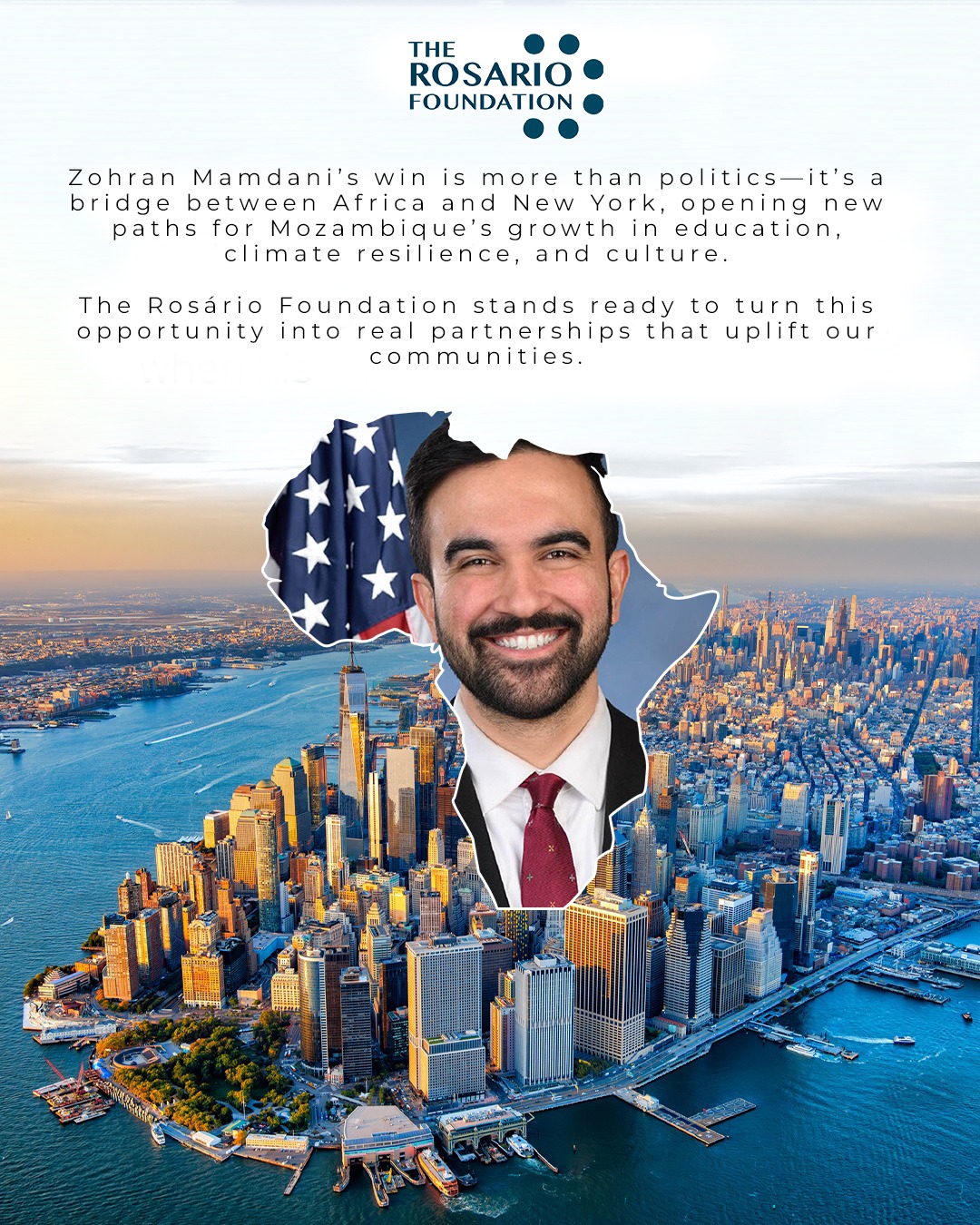
Zohran Mamdani’s election represents far more than a generational shift in New York politics, it is a bridge of consciousness between Africa and one of the world’s most influential metropolises.
A son of the continent, raised within the moral and intellectual tradition of his father Mahmood Mamdani, now sits at the helm of a global city that defines finance, media, culture, and philanthropy.
This is not just symbolic; it opens new corridors for partnership, policy exchange, and people-to-people engagement that can greatly benefit Africa and Mozambique in particular.
From a geopolitical and developmental perspective, this election signals a convergence between progressive urban governance and Africa’s aspiration for equitable global inclusion. A leader shaped by the ethics of justice, inclusion, and diversity will likely champion partnerships that align with the SDGs, AfCFTA, and the African Union’s Agenda 2063.
For Mozambique, this creates a golden opportunity to project its developmental agenda (particularly around sustainable cities, the blue economy, youth employment and community resilience) within the global networks of influence centered in New York.
Now, where does The Rosário Foundation (TRF) fit in this new ecosystem?
Precisely at the intersection where vision meets opportunity. I think that TRF can be both a catalyst and conduit for Mozambique–New York cooperation across multiple strategic domains.
First, in the field of education, skills and research, TRF can facilitate academic partnerships between Mozambican universities and New York institutions such as Columbia, NYU, and CUNY by creating exchange programs for youth leadership, entrepreneurship, climate adaptation, and Islamic finance. This is consistent with TRF’s vision of empowering Mozambican youth through knowledge transfer and applied learning.
It would embody the Qur’anic principle that “Allah will raise in degrees those of you who have been granted knowledge” (Surat Al-Mujadila, 58:11).
Second, in the area of urban regeneration and community development, the TRF model of integrated centers (CEDECOINs) mirrors the inclusive social infrastructure philosophies currently shaping New York’s urban renewal agenda.
By aligning with the Mayor’s office and New York’s philanthropic networks, TRF could pilot joint projects on affordable housing, technical education, and social entrepreneurship in Maputo, Beira, and Nampula. Such projects could be co-financed by New York-based foundations (Ford, Rockefeller, Open Society, Bloomberg Philanthropies) seeking credible African partners that combine transparency, ethics, and tangible impact.
Third, in the field of climate resilience and blue economy, New York’s leadership in coastal protection, green finance, and urban climate planning offers immense learning and partnership potential for TRF’s coastal initiatives, especially in Ilha de Moçambique, Nacala, Zambézia and Maputo. By connecting TRF’s blue-economy programs to New York’s sustainability networks and diaspora investors, Mozambique could access innovative financing for mangrove restoration, sustainable fisheries, and eco-tourism considered key to transforming vulnerability into resilience.
Fourth, the creative industries and cultural diplomacy dimension offers a powerful soft-power avenue. TRF can partner with African diaspora artists, universities and media houses in New York to promote Mozambican literature, music and cinema using culture as a medium of economic empowerment and narrative reclamation.
As the Bible says, “A city set on a hill cannot be hidden” (Matthew 5:14); and Mozambique’s story, told with dignity, can illuminate Africa’s modern renaissance.
Fifth, the digital transformation and innovation ecosystem of New York can help TRF scale its educational and community programs through technology such as in edtech, agri-tech and healthtech. Partnerships with NY-based startups and social impact funds could equip TRF’s centers in Mozambique with the tools to digitize learning, connect farmers to markets and expand telemedicine access in rural communities.
Finally, there is a moral and spiritual synergy. Zohran Mamdani’s worldview (shaped by pluralism, compassion, and justice) resonates with the foundational values of TRF: that development must be holistic, ethical and inclusive.
The Qur’an reminds us, “Indeed, Allah commands justice, excellence, and generosity to relatives” (Surat An-Nahl, 16:90), and African philosophy affirms that “a person is a person through others.”
In that spirit, TRF can serve as a platform of ethical cooperation between Africa and the diaspora connecting resources, intellect and faith to serve humanity.
In summary, Mamdani’s election gives Africa, and Mozambique in particular, access to a new center of gravity in global city diplomacy. It opens the door for Mozambique to project itself not as a peripheral recipient of aid but as a partner in innovation, resilience, and ethical leadership.
The Rosário Foundation, through its integrated community model, stands uniquely positioned to translate this opportunity into concrete partnerships in education, urban transformation, blue economy, culture, and digital inclusion.
As always, history favors those who prepare.
And perhaps, as African wisdom says, “When the lion opens its eyes at dawn, the savannah rearranges itself.”
The dawn has come; it is time for Mozambique, through TRF, to stand tall in the new light.

Leave a Reply